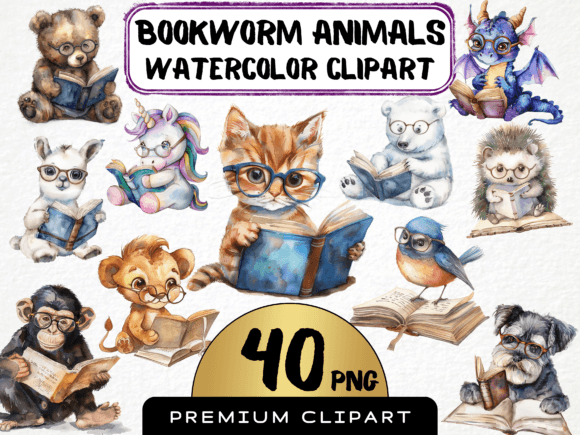
Watercolor Bookworm Animals Clipart PNG for Creative Projects
If you have ever hunted for design assets that feel warm, whimsical, and genuinely inviting, you have probably come across illustrated animal characters reading books. The Watercolor Bookworm Animals Clipart PNG collection brings that concept to life with a hand-painted aesthetic that works for everything from children's book layouts to branding for independent bookstores. These are not stiff vector icons or generic cartoon animals. Each piece carries the soft edges, color blending, and organic imperfections that make watercolor illustration feel alive.
The set typically includes a range of animal characters—foxes, owls, bears, rabbits, cats, and sometimes more unusual creatures—each shown reading, holding, or sitting on books. The watercolor technique gives them a gentle, storybook quality. Colors are layered rather than flat, edges are soft rather than sharp, and the overall mood leans cozy and inviting. Whether you are designing for a young audience or trying to evoke nostalgia and comfort in adult-focused work, this clipart style delivers a genuine emotional hook.
Visual Personality and Design Appeal
What sets Watercolor Bookworm Animals Clipart PNG apart from standard vector illustrations is the texture. Real watercolor has unpredictable gradients, subtle paper grain, and variations in opacity that digital tools struggle to replicate perfectly. When you place one of these PNG files onto a solid background or a patterned page, it does not sit flat. It breathes. That makes it especially effective in projects where you want the artwork to feel handcrafted.
The characters typically lean cute but not saccharine. Expressions are warm and curious rather than exaggerated. A fox might peer over a pair of glasses, a bear might hold a book with both paws, and a rabbit might be perched on a stack of volumes. The books themselves are often painted in contrasting colors, adding visual interest without competing with the animal. This balance is important when using the clipart in layouts where text is present.
Because each element is rendered as a transparent PNG, you can layer them freely. That gives you control over composition without needing to cut out backgrounds yourself. You can group multiple animals together, arrange them on a bookshelf illustration, or place them over a solid color field for a clean, modern look.
Where This Clipart Works Best
The range of applications for Watercolor Bookworm Animals Clipart PNG is broader than you might expect. While it is obviously a natural fit for children's publishing, it also performs well in branding, marketing, and digital design contexts where warmth and personality are priorities.
- Children's books and educational materials – This is the most obvious use case. The watercolor style complements illustrated books, worksheets, flashcards, and classroom decor. Because the PNGs are high resolution, they print cleanly at various sizes.
- Bookstore and library branding – Independent bookshops, reading nooks, and libraries often struggle to find visual assets that feel both professional and approachable. These illustrations work on signage, tote bags, bookmarks, social media profiles, and website headers.
- Social media graphics – Instagram posts, Pinterest pins, Facebook cover images, and story templates all benefit from authentic, non-stock imagery. Using watercolor clipart gives your feed a consistent visual identity that stands out from the templated look many brands rely on.
- Product packaging – If you sell candles, stationery, subscription boxes, or gift sets related to reading or cozy living, this clipart can be integrated into labels, hang tags, and insert cards. The texture translates well to print on matte or uncoated paper stocks.
- Blog and website design – Bloggers covering reading, parenting, homeschooling, or lifestyle topics can use these images as featured graphics, section dividers, or bullet point icons. They bring a cohesive visual thread to posts without requiring custom illustration every time.
- Party printables and event materials – Reading-themed birthday parties, baby showers, or book club events benefit from matching invitations, banners, cupcake toppers, and thank-you cards. Watercolor gives those items a premium, handmade feel.
One practical observation: if you are designing for digital screens, the watercolor texture still reads well, but you may need to adjust contrast slightly. On backlit displays, very soft watercolor washes can appear lighter than they do on paper. A quick test on your target screen before finalizing layouts saves time.
Influencing Visual Hierarchy and Brand Perception
Design is about guiding attention, and Watercolor Bookworm Animals Clipart PNG can play a role in establishing visual hierarchy without relying on typography alone. When you place a large animal character near a headline, the eye naturally moves from the illustration to the text. That sequence—image first, message second—works well for hero sections, book covers, and landing pages where you want to capture interest fast.
For brand perception, watercolor communicates values that sharp vector art often does not: patience, handmade quality, creativity, and warmth. If your business or project revolves around reading, learning, childhood, or storytelling, this style reinforces that identity at a glance. Customers and audiences subconsciously associate the texture with children's literature, artistic care, and a slower, more thoughtful pace.
Consistency is another factor. When you use the same clipart set across multiple touchpoints—your website, social media, email headers, printed handouts—recognition builds. People start to expect that warm, illustrated look when they encounter your brand. Over time, that association becomes part of your visual equity.
Practical Guidance for Choosing and Using the Set
Before you purchase or download any Watercolor Bookworm Animals Clipart PNG collection, a few practical considerations will help you evaluate fit for your project.
Check the included styles and characters. Not all sets are the same. Some include only three or four animals, while others offer a dozen or more. If you plan to use the clipart across multiple projects or need variety for a book series, look for a larger set with diverse poses, expressions, and accessories. Also verify whether the books themselves are included as separate elements. That can save you compositing time later.
Review image resolution and transparency. Most quality PNG clipart comes at 300 DPI or higher, suitable for both screen and print. Lower resolution files may look fine on a phone screen but pixelate when printed on a poster or book cover. Always check the file dimensions before committing. Transparent backgrounds are standard, but some sets include white halos around the painted edges. Preview a sample overlay on a dark background to see how the watercolor sits.
Consider readability and composition. When placing clipart near text, allow enough padding. Watercolor edges are irregular, so text should not crowd the painted area. Use the clipart as an accent rather than a busy backdrop. A single large animal paired with a short headline is often more effective than scattering multiple illustrations across a dense layout.
Test font pairings early. Since the clipart has a hand-painted, organic feel, it pairs naturally with serif fonts, handwritten styles, and soft sans serifs. Avoid rigid, ultra-modern typefaces that clash with the watercolor texture. Some reliable pairings include Playfair Display for headings with Lato for body text, or a script font like Pacifico for accent words against a clean sans serif. Test a few combinations on a sample layout before committing.
Review commercial licensing terms. If you are designing for a client, selling products, or using the clipart in marketing materials, confirm that the license covers commercial use. Some sets restrict use in certain contexts, such as resale of digital templates or use in logo design for multiple clients. Read the license carefully to avoid issues later. Many premium clipart packs offer extended licenses for a higher fee, which may be worthwhile if the artwork becomes central to your brand identity.
Realistic Design Observations
One thing I have noticed working with watercolor clipart sets is that they can sometimes be challenging to scale. A small animal that looks charming on a business card might lose its delicate paint strokes when printed tiny. If you are designing for small formats—stickers, tags, icons—check how the artwork holds up at reduced sizes. On the flip side, enlarging watercolor PNGs beyond their native resolution can reveal pixelation or brush stroke artifacts. Stick close to the original size range for best results.
Another observation: watercolor clipart tends to pair well with solid geometric shapes. A circle, square, or rounded rectangle behind the PNG can anchor the organic illustration and give it a modern frame. This technique is common in logo design and social media avatars, where you need a clean silhouette but want the interior artwork to feel natural.
Finally, consider using a consistent color palette drawn from the clipart itself. If the fox in your set features warm oranges and muted browns, pull those colors into your text, background, or graphic accents. This creates a unified visual system without extra effort. The best projects using Watercolor Bookworm Animals Clipart PNG are those where the illustration and the surrounding design feel like they belong together, not like the clipart was dropped in as an afterthought.